Hyperbaric oxygen
The chamber
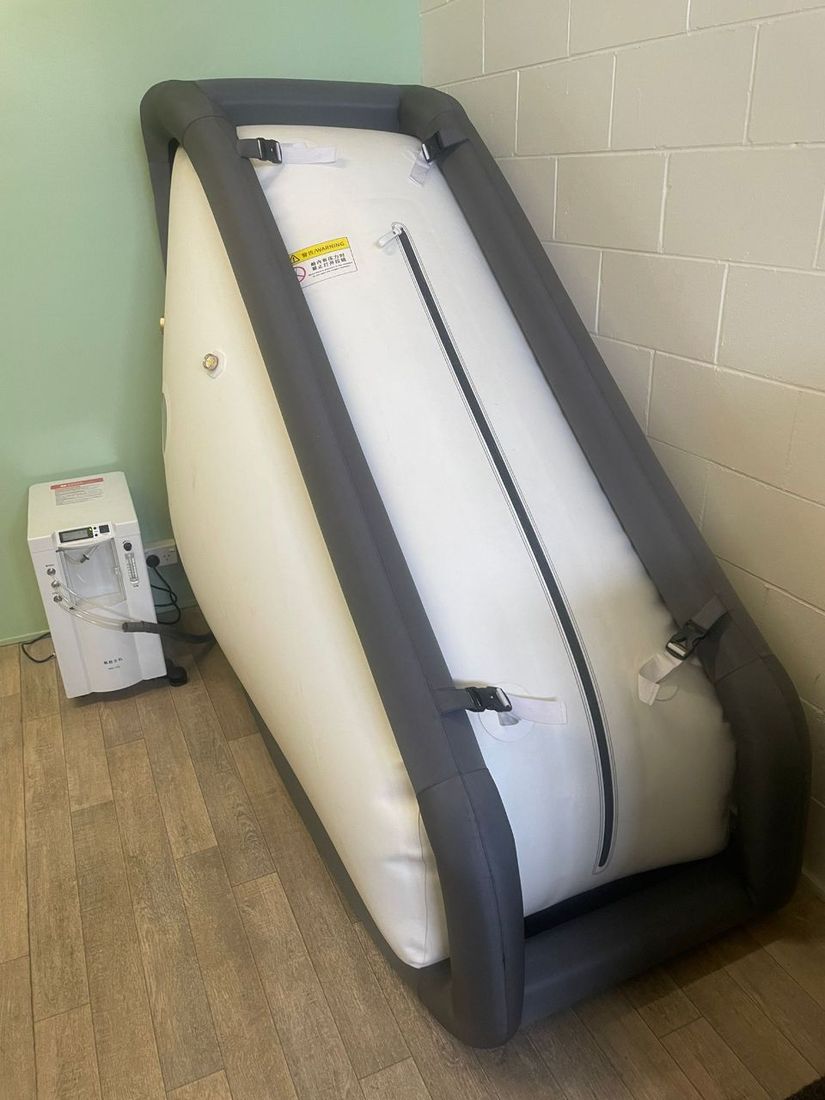
We have a 1.5 ATA hyperbaric oxygen chamber here in the clinic on Great South Road — the closest one to Papakura. Sessions run 30 or 60 minutes.
What it actually is
You lie down inside a sealed chamber and the air pressure around you is raised to about one and a half times what it is outside — roughly the pressure you would feel five metres underwater. At the same time an oxygen concentrator feeds oxygen-enriched air into the chamber.
Pressure changes how much oxygen your blood can carry. Normally almost all of it is carried by your red blood cells, and those are close to full at sea level. Under pressure, extra oxygen dissolves directly into the plasma — the fluid part of your blood — and plasma goes everywhere blood goes.
That is the whole idea. More oxygen in circulation, for an hour, without you doing anything.
Why we have one
Dr Kelly came off a horse hard enough to give herself a serious concussion, and had a long recovery while she was studying. The chamber is here in large part because of that.
It is not a common thing for a clinic this size to own. No other practice in Papakura has one.
What a session is like
Getting in
You lie down, the chamber is zipped closed, and pressure comes up slowly over several minutes. Your ears will need to equalise, exactly as they do when a plane comes in to land. Yawning or swallowing sorts it out.
During
There is nothing to do. Most people sleep, listen to something, or just lie there. You can talk to us the whole time and we can bring you out whenever you want.
Coming out
Pressure comes back down gradually and your ears equalise again on the way out. Most people feel like they have had a long nap.
Wear comfortable clothes. Come in reasonably hydrated, and go to the loo first — an hour is an hour.
What it may be helpful for
Hyperbaric oxygen has been studied for a long time. Most of that research uses hospital chambers at much higher pressures. The chamber here runs at 1.5 ATA, so below is what has been looked at at this pressure specifically.
After a concussion
Where symptoms have carried on longer than expected after a knock to the head, trials run at 1.5 ATA have reported improvement in symptoms and in thinking and concentration. More research exists on this than on any other use at this pressure.
Persistent musculoskeletal pain
Reviews of pain conditions, including fibromyalgia and recovery after some orthopaedic surgery, report reductions in pain and modest improvements in day-to-day function.
It sits alongside the rest of what we do rather than replacing any of it, and it may not help you. Come and talk to us about whether it is worth trying before you book a course of sessions.
We do not claim it treats or resolves any condition, and you will not find the usual wellness language on this page. What is above is what the research at this pressure actually looked at.
When it is not suitable
Tell us before you book if any of these apply. Some rule it out, some just mean we talk first.
- A cold, flu, sinus congestion or any chest infection — wait until it clears
- Recent ear or sinus surgery, or grommets
- Trouble equalising your ears on a plane
- Any lung condition, or a collapsed lung at any point
- Current or recent chemotherapy — some drugs interact
- Epilepsy or a seizure disorder
- Pregnancy
- Strong claustrophobia — come and look at it first, unzipped
If you are under a doctor for anything ongoing, check with them first. We would rather you did.
Sessions and booking
- 30 minutes
- $50
- 1 hour
- $100
Book online, or call and we will talk it through first if you have not used one before.